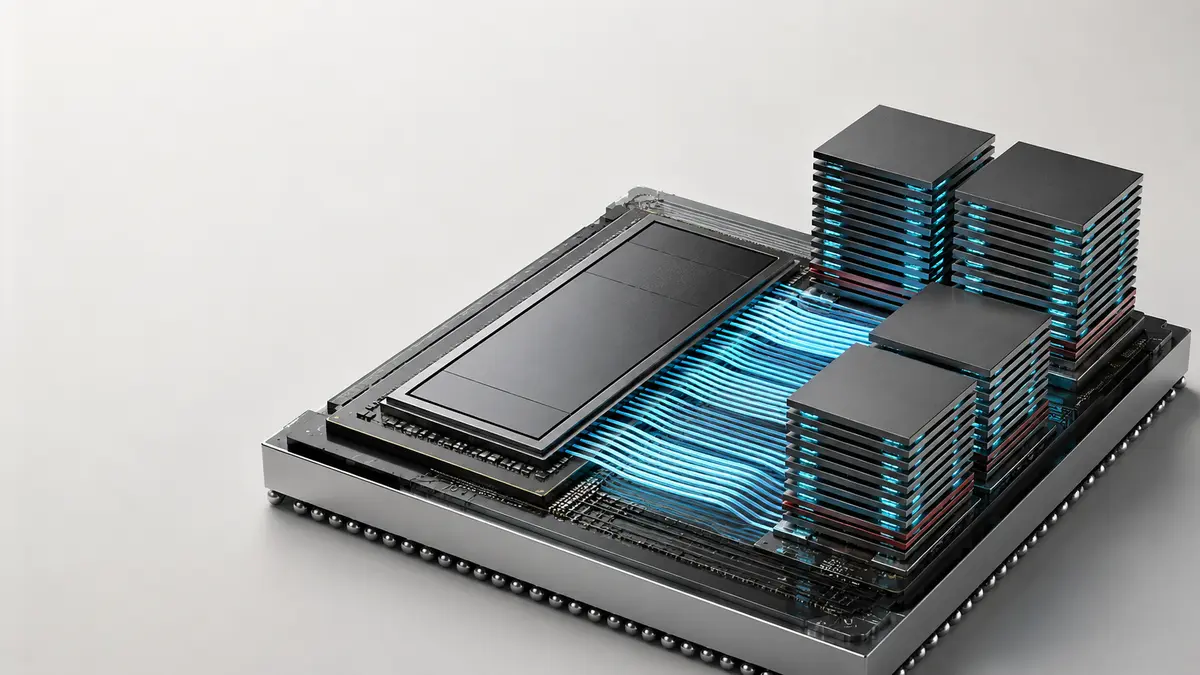
Modern AI chips can do an absurd amount of arithmetic. Keeping those arithmetic units fed with model weights, activations, and intermediate results is often the tougher job.
NVIDIA's H100 SXM pairs up to 1,979 teraFLOPS of FP16 Tensor Core performance with 3.35 terabytes per second of memory bandwidth.[1] They are different measurements, so there is no useful shortcut in dividing one by the other. Still, the mismatch points to a real engineering constraint: a workload that has to move too much data per calculation can run out of memory bandwidth while compute capacity sits idle.
I think of an AI accelerator as a factory with very fast assembly lines and a crowded road outside. Compute is the machinery. Memory is the road bringing in parts. More machines do not help much when the trucks cannot get through. HBM makes that road much wider and puts it close to the processor.
Memory is not the only thing that can hold an AI system back. Networking, power, cooling, software, and advanced packaging matter too. But in large-model training and inference, capacity and bandwidth often decide how much of a very expensive GPU gets used.
What HBM Actually Is - in Plain English
For an investor, three things matter.
HBM stacks DRAM dies vertically instead of placing memory packages around a circuit board. Tiny vertical connections, called through-silicon vias, move data through the stack. The result is a very wide path close to the GPU, rather than the narrower and longer routes used by conventional memory modules.
It is also a packaging and manufacturing problem, not merely a better memory chip. Each additional layer gives defects, warpage, heat, and weak electrical connections another chance to show up. A single bad die can spoil the economics of the whole stack. That is why the announced speed matters less than the ability to ship qualified stacks at good yields.
And every new generation asks more of the supplier at once. SK hynix's 12-layer HBM3E entered volume production in September 2024 with 36GB of capacity and a stated operating speed of 9.6Gbps. The company said its DRAM dies were 40% thinner, allowing 12 layers to fit within the height of its prior eight-layer product; it used MR-MUF packaging to manage warpage.[2]
HBM4 takes the memory chip deeper into the package design. In April 2024, SK hynix and TSMC said they would co-develop the HBM4 base die on TSMC's advanced logic process and optimize HBM for TSMC's CoWoS packaging, with mass production targeted from 2026.[3] At that point, memory and logic are no longer separate boxes on a spec sheet.
SK Hynix vs. Samsung vs. Micron: Who Is Actually Winning?
SK hynix led the HBM3E commercialization cycle. Samsung and Micron were never out of the race, though, and the public disclosures do not produce one clean, audited HBM market-share table. That is worth keeping in mind whenever a headline declares a winner.
| Company | Publicly disclosed signal | What it does and does not show |
|---|---|---|
| SK hynix | HBM exceeded 40% of 4Q24 DRAM revenue;[4] FY25 HBM revenue more than doubled year on year.[5] | HBM is a material earnings driver; it does not disclose a precise HBM market share. |
| Samsung | Record 4Q24 memory revenue, supported by higher HBM and server DDR5 sales.[6] | HBM was contributing; Samsung did not break out HBM revenue. |
| Micron | HBM revenue crossed $1 billion in fiscal Q2 2025.[7] | Micron is a real third supplier; the figure is not directly comparable with SK hynix's undisclosed HBM revenue. |
SK hynix said HBM was more than 40% of its DRAM revenue in the fourth quarter of 2024. For the full year, revenue reached KRW 66.2 trillion and operating profit KRW 23.5 trillion.[4] A year later, it said 2025 HBM revenue had more than doubled; total revenue was up 47% to KRW 97.1 trillion and operating profit was up 101% to KRW 47.2 trillion.[5] That is a meaningful earnings contribution, even without a precise HBM revenue number.
Samsung's fourth-quarter 2024 release said higher HBM and server DDR5 sales helped its memory business reach record quarterly revenue and lifted its blended DRAM selling price. It did not break out HBM revenue.[6] Micron gave investors a cleaner milestone: HBM revenue passed $1 billion in fiscal Q2 2025, against total company revenue of $8.05 billion.[7]
TrendForce put Samsung first in total fourth-quarter 2024 DRAM revenue at $11.25 billion, followed by SK hynix at $10.46 billion and Micron at $6.4 billion. It attributed SK hynix's 36.6% total DRAM share in part to higher HBM3E shipments.[8] Useful context, but still total DRAM data, not HBM share.
Why HBM Is SK Hynix's Moat - Not Just a Product Cycle
I would call SK hynix's advantage a moat under constant attack, not an unbridgeable lead. It comes from work that happens long before an HBM stack appears in an earnings presentation.
Start with qualification and planning. SK hynix said in April 2025 that HBM supply volumes are agreed with customers roughly a year in advance.[10] TrendForce has said earlier HBM3 and HBM3E eight-layer products needed at least two quarters of yield learning, while 12-layer products faced another validation cycle.[11] Once a stack has passed qualification inside an accelerator and the capacity is booked, changing suppliers is nothing like buying commodity DRAM in the spot market.
Then there is the package itself. CoWoS puts the GPU or other accelerator and HBM on an interposer inside one advanced package. SK hynix and TSMC are working together on the HBM4 base die and on HBM-CoWoS integration.[3] That does not make TSMC exclusive to SK hynix. It does mean SK hynix gets early chances to solve electrical, thermal, and packaging issues with the foundry at the center of the AI supply chain.
The manufacturing learning is harder to see from the outside, and probably harder to copy than a product announcement suggests: thinner dies, TSV connections, heat, MR-MUF packaging, yields, and customer qualification all have to work at volume.[2] The point is not that SK hynix is permanently a generation ahead. It is that every generation starts with the process lessons of the last one.
Customers also have good reasons to qualify more than one supplier: capacity, pricing leverage, and resilience. Samsung and Micron are moving forward on HBM4. So I would not put a fixed three- or four-year clock on anyone catching up. The advantage is that rivals have to match SK hynix on process execution and customer coordination again at every generation.
What This Means for ADR Investors
For SKHY investors, HBM first changes the value of the underlying SK hynix business. Revenue mix, gross margin, capital intensity, and customer concentration will feed into the earnings investors assign to the Korean ordinary shares, and therefore to the depositary shares.
I would pay closer attention to HBM revenue growth and its contribution to DRAM revenue or margins than to broad AI-demand headlines. Qualification and volume-allocation news for the next accelerator platform matters too. And the quality of that growth matters: higher HBM sales are more useful when yields and cash generation hold up, rather than when they simply require more capital spending.
There is one distinction worth keeping clear. HBM strength alone does not say whether SKHY should trade at a bigger premium to KRX:000660. Both securities reflect the same HBM fundamentals. Their relative price can still move for much more mechanical reasons: the ADS ratio, USD/KRW, trading hours, investor access, liquidity, conversion constraints, and the supply of depositary shares.
That is why I built the SKHY Premium Calculator. It compares the U.S. depositary share with KRX:000660 using the exchange rate and official ADS ratio. The methodology explains the calculation, and premium history shows how the gap has moved. HBM helps answer what the business may be worth; the premium shows what U.S. market access to that same business costs today.
References
- NVIDIA, NVIDIA H100 Tensor Core GPU, product specifications, accessed July 26, 2026.
- SK hynix, SK hynix Begins Volume Production of the World's First 12-Layer HBM3E, September 26, 2024.
- SK hynix, SK hynix Partners with TSMC to Strengthen HBM Technological Leadership, April 19, 2024.
- SK hynix, SK hynix Announces 4Q24 Financial Results, January 23, 2025.
- SK hynix, SK hynix Announces FY25 Financial Results, January 28, 2026.
- Samsung Electronics, Samsung Electronics Announces Fourth Quarter and FY 2024 Results, January 31, 2025.
- Micron Technology, Results for the Second Quarter of Fiscal 2025, March 20, 2025.
- TrendForce, Server DRAM and HBM Continue to Drive Growth, February 27, 2025.
- TrendForce, HBM4 Validation Expected in 2Q26, February 13, 2026.
- SK hynix, SK hynix Announces 1Q25 Financial Results, April 24, 2025.
- TrendForce, HBM3E 12-Hi Faces Yield Learning Curve and Customer Validation Challenges, September 30, 2024.