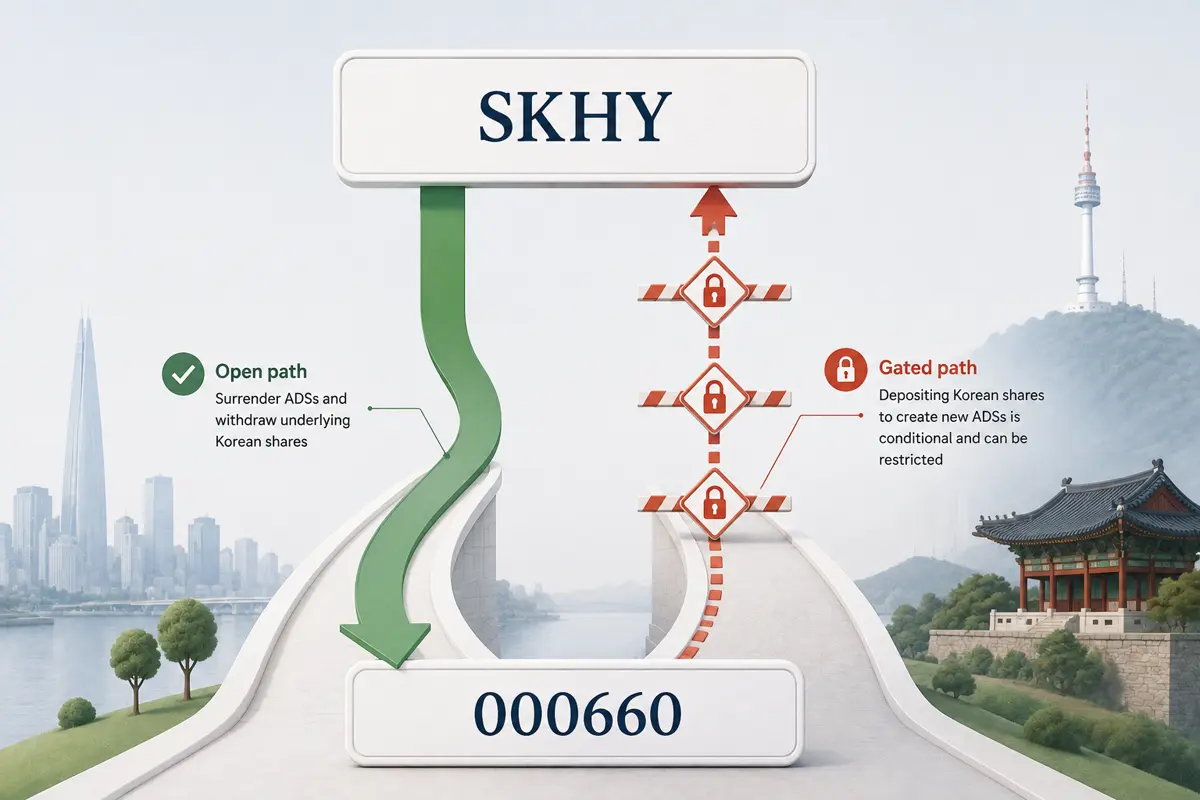
Up front:
- SKHY → Korean shares: A holder of SKHY American Depositary Shares (ADSs) can surrender the ADSs and withdraw the underlying SK hynix common shares, subject to fees, documentation, taxes, and applicable law.[1][2]
- Korean shares → SKHY: The deposit agreement contemplates depositing Korean common shares to create new SKHY ADSs, but the process is subject to specific conditions and restrictions. In certain circumstances, the depositary and custodian must or may refuse to accept shares for deposit.[2]
- The two directions are not symmetric. SK hynix itself warns that shares withdrawn from the ADS facility "may not be allowed" to be redeposited.[1]
The rest of this piece walks through why the two directions are not mirror images, what conditions apply to each, and why a visible SKHY premium does not automatically become a risk-free conversion arbitrage.
What one SKHY ADS actually represents
SKHY consists of American Depositary Shares (ADSs) traded in the United States, each representing an interest in an ordinary share listed in Korea. The setup, per SK hynix's offering documents:[1][2]
| Element | Detail |
|---|---|
| U.S. ticker | SKHY (Nasdaq) |
| Underlying security | SK hynix common share, KRX: 000660 (Seoul, KRW) |
| ADS ratio | 1 ADS = 1/10 of one common share, i.e. 10 ADSs = 1 common share[1][2] |
| Depositary bank | Citibank, N.A.[2] |
| Offering size | 177,900,000 ADSs[1] |
The 10:1 ratio defines the contractual ADS-to-share relationship; it does not by itself guarantee unrestricted conversion in both directions. It tells you how many ADSs map to one share inside the facility, not that an investor can move securities both ways on demand.
How SKHY ADSs convert into Korean shares
The SKHY → 000660 move is a cancellation, not a trade. The holder, generally through the applicable securities-intermediary process, surrenders SKHY ADSs to the depositary; the ADSs are cancelled; and the Korean custodian delivers the corresponding underlying common shares.[2]
→ Korean custodian releases deposited shares → KRX:000660 common share delivered
Under the deposit agreement, ADS holders are entitled to surrender ADSs and withdraw the deposited securities, subject to a limited set of permitted restrictions (below).[2] One practical wrinkle: the depositary will not accept a surrender of ADSs representing less than one whole share, so a withdrawal has to cover enough ADSs to map to whole Korean shares.[2]
Conditions that apply to SKHY → Korean share withdrawals
The withdrawal right is real but not unconditional. The deposit agreement and applicable rules let the depositary impose temporary or legal limits, and the holder has to clear the usual procedural hoops:[2] valid delivery instructions and any required forms; ADS cancellation fees, plus any applicable taxes, governmental charges, and share-registration fees; U.S. and Korean legal and regulatory requirements, including exchange-control and securities-law rules; the Korean central securities depository's rules and any transfer-book or register closures; and brief suspensions around shareholder meetings, dividends, or the other exceptions the deposit agreement and Form F-6 allow.[2]
None of that closes the door. It just means the right runs inside a legal and procedural frame, not as an instant, costless button.
Can Korean SK hynix shares be converted into SKHY?
In principle, yes. The deposit agreement does contemplate a reverse flow: deliver common shares to the custodian, the depositary confirms receipt, and new ADSs are issued.[2]
→ [regulatory, company-consent, and limit checks] → new SKHY ADSs issued
This is where the asymmetry begins: the creation side is subject to broader conditions and refusal rights, while the withdrawal side is protected more strongly and subject to a narrower set of permitted restrictions. The same agreement that opens the deposit pathway also lists the gates a deposit has to clear before any new ADSs exist.[2]
Why the depositary can refuse to create new SKHY ADSs
The agreement gives the depositary and custodian several grounds to refuse a deposit, while SK hynix can trigger or impose certain restrictions through company instructions, deposit limits, and required consent. The main ones:[2]
- If the shares are restricted securities, or accepting them would break U.S. law, Korean law, SK hynix's articles of incorporation, or securities regulation, the deposit can be refused.
- SK hynix can direct the depositary in writing, where reasonably necessary to comply with the law, not to accept specified shares.
- A deposit that would cause the total number of deposited shares to exceed a level determined by SK hynix must be refused.
- The depositary can make any deposit conditional on SK hynix's prior written consent, used for example to confirm that Korean-law conditions are met and any required registration statement or filing is in place and effective. No consent, no deposit.
- Where a deposit would require SK hynix to file a Korean registration statement or other regulatory filing, the company does not guarantee it will make the required filing or grant the necessary consent.[1]
Why you may not be able to convert back into SKHY
SK hynix states the core point directly in its risk factors. From the prospectus:[1]
"If you surrender your ADSs in order to withdraw the underlying common shares, you may not be allowed to deposit the common shares again to obtain ADSs."
The key point is that withdrawal does not guarantee redeposit; the reverse path remains conditional. The disclosure goes on: common-share holders can in principle deposit shares and obtain ADSs, and ADS holders can surrender ADSs and receive shares, but some deposits require SK hynix's prior consent, deposits above a set maximum may need company approval, the depositary or custodian may be unable to accept a deposit in some situations, and where a Korean registration statement or other filing would be required, the company does not guarantee it will file, nor that it will grant the consent.[1][2]
Withdrawal does not guarantee redeposit. Cancel SKHY to take out Korean shares, and you are not promised you can put those same shares back in to recreate SKHY.
Is SKHY conversion really two-way?
The honest word is "asymmetric," not "two-way." The two directions play by different rules:
| Direction | Mechanism | Guaranteed? | Main limitations |
|---|---|---|---|
| SKHY → Korean shares | ADS cancellation / withdrawal of deposited securities[2] | Generally available, subject to conditions | Fees, taxes, documentation, law, CSD rules, temporary delays, whole-share requirement |
| Korean shares → SKHY | Share deposit + ADS issuance[2] | No, conditional | Company prior consent, deposit limit, legal/regulatory compliance, restricted-securities rule, depositary/custodian acceptance |
Do not reduce it to yes or no. The withdrawal side is a fairly protected right inside a procedural frame; the creation side is a permissioned path with several checkpoints that can close. The 10:1 ratio does not change that.
How much SKHY ADR conversion costs
The deposit agreement's fee schedule caps the depositary's own charges:[2]
| Action | Depositary fee (cap) |
|---|---|
| ADS issuance (on deposit of shares) | Up to US$5.00 per 100 ADSs (or fraction thereof)[2] |
| ADS cancellation (on surrender/withdrawal) | Up to US$5.00 per 100 ADSs (or fraction thereof)[2] |
That cap covers one line item, the depositary's fee, not the whole cost of converting. On top of it, an investor can also owe taxes and government charges, share-registration fees, SWIFT and transmission costs, custodian or nominee expenses, exchange-control or other compliance costs, and whatever the executing broker charges separately.[2] The US$5-per-100-ADS figure is only the maximum depositary issuance or cancellation fee under the agreement, not the total cost an investor may incur.
What this means for SKHY premium investors
Before any conversion or arbitrage question, you first need to see the gap clearly: how large the premium is, whether both markets are open at once, whether the math uses the correct 10:1 ratio, and what FX rate is applied.[3] The SK Hynix ADR Premium Calculator does that comparison in real time, and the premium history page shows whether a spread is persistent or a one-off. Both are informational tools, not trade signals.
The narrower takeaway: do not treat a displayed premium as a quote for an executable, risk-free conversion trade. The securities are economically linked, but the bridge between them is more open in one direction and more heavily gated in the other, and that asymmetry may be one structural contributor to the frictions that allow a depositary-receipt premium to persist alongside market hours, investor segmentation, liquidity, FX, and settlement.[4]
References
- SK hynix Inc., Final Prospectus (Rule 424(b)(4)), July 9, 2026, SEC Registration No. 333-296987. ADS ratio (1 ADS = 1/10 common share), 177,900,000-ADS offering, and risk factor: "If you surrender your ADSs in order to withdraw the underlying common shares, you may not be allowed to deposit the common shares again to obtain ADSs."
- SK hynix Inc. and Citibank, N.A., Deposit Agreement (Exhibit (a) to Form F-6), filed July 1, 2026, SEC File No. 333-297185. Sections 2.3, 2.5, 2.7, 2.8, and 5.9 and Exhibit B govern share deposits, ADS issuance, ADS surrender and withdrawal, restrictions and suspension, and fees. Exhibit B caps the depositary's issuance and cancellation fee at up to US$5.00 per 100 ADSs (or fraction thereof).
- SKHY Premium, SKHY Premium Methodology: parity per ADS = 000660 close ÷ USD/KRW ÷ 10; premium = SKHY ÷ parity − 1. Defines the displayed premium the conversion question is usually trying to exploit.
- SKHY Premium, Why SKHY Trades at a Premium: structural reasons a depositary-receipt premium can persist, including non-overlapping market hours, investor segmentation, liquidity, FX, and settlement friction.