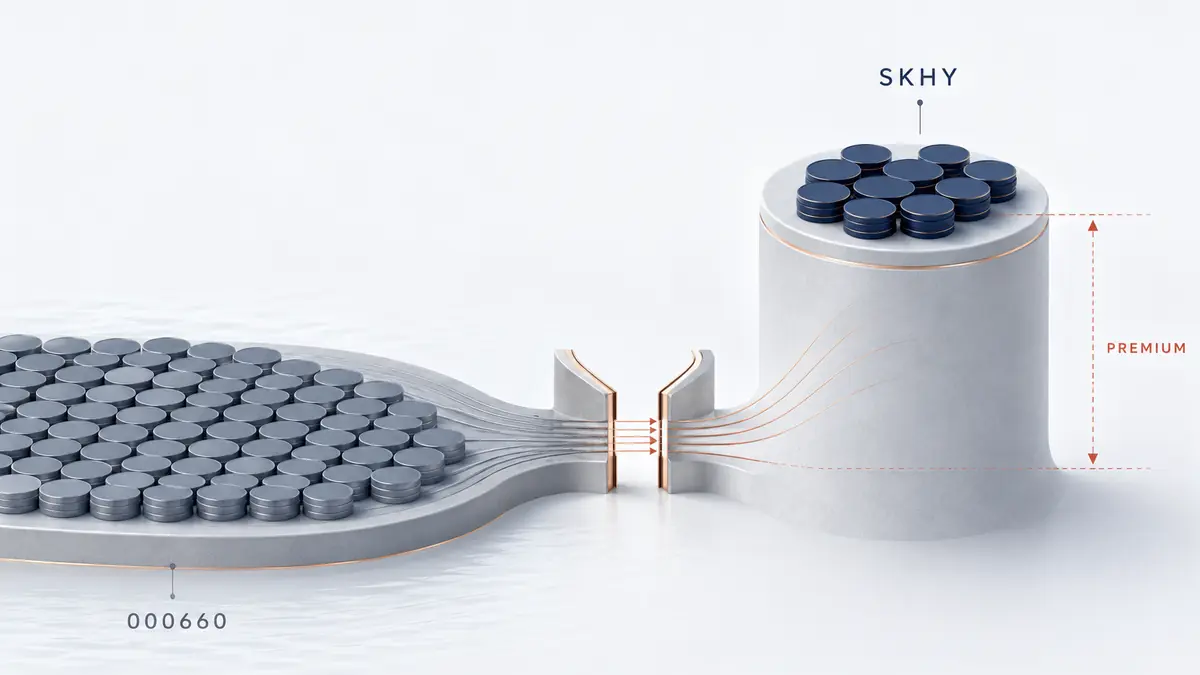
There are now two very different ways to own SK hynix. You can buy the ordinary shares in Seoul under KRX: 000660, or you can buy the U.S.-listed American Depositary Shares under Nasdaq: SKHY.
The economic link between them is not complicated. SK hynix's final U.S. prospectus states that each SKHY ADS represents one-tenth of one common share.[1] So 10 SKHY ADSs = 1 SK hynix common share.
And yet SKHY has repeatedly traded above the currency-adjusted value implied by 000660.
Asking whether SKHY is "expensive" is the wrong first question. The more useful one is: what prevents the two prices from immediately converging?
The answer is structural. Strong U.S. demand meets a relatively small pool of SKHY ADSs, and the mechanism for creating new ADSs from Korean shares is neither frictionless nor unlimited. On top of that sit different investor bases, trading hours, currencies and market-access rules. What you end up with is less a valuation difference than a scarcity premium attached to one particular way of owning SK hynix.
First, What Exactly Is the SKHY Premium?
Because each ADS is one-tenth of a Korean common share, the two securities can be compared once you adjust for the exchange rate.
If USD/KRW is the number of Korean won per U.S. dollar, the approximate parity value of one SKHY ADS is:
The premium is then:
or equivalently:
If SKHY trades above parity, it trades at a premium to the Korean shares. For a full walkthrough of the calculation, including FX direction, stale-price issues and worked examples, see our How to Calculate ADR Premium: Step-by-Step Guide.
This article is about the other question: why arbitrage doesn't automatically erase that premium.
SKHY Was Born Into an Unusually Strong Demand Environment
SK hynix's Nasdaq listing arrived when U.S. investors were intensely focused on AI infrastructure and high-bandwidth memory. Trading began on July 10, 2026, and the company said the move was designed to broaden its global investor base in U.S. capital markets.[2] The ADR structure also solved a practical access problem: SK hynix noted that ADRs let U.S. investors buy foreign companies through the U.S. market without opening an overseas brokerage account or dealing directly in foreign currency.[2]
Appetite was obvious before the first trade. SKHY priced at $149 per ADS and raised about $26.5 billion; Reuters, citing a person familiar with the matter, reported demand at more than seven times the amount on offer.[3]
That matters here because a premium needs more than two trading venues. It needs demand to be unusually strong for one form of the security. SKHY gave U.S. investors something they hadn't had before in the same form: a large, liquid, dollar-traded Nasdaq security with direct SK hynix exposure. In other words, demand showed up for the wrapper, not just the company.
But the Initial SKHY Supply Was Relatively Small
The other side of the equation is supply. The final SEC prospectus shows SK hynix offered 177.9 million ADSs,[1] which, at ten ADSs per common share, is 17.79 million common shares, about 2.50% of SK hynix's total issued common shares before the offering.[1]
So: a large potential U.S. investor base, and a comparatively limited pool of U.S.-listed ADSs.
On its own, that wouldn't necessarily produce a persistent premium. If new ADSs could be created freely whenever SKHY got expensive, arbitrageurs would simply add supply. Under the conversion framework reported by the Korea Securities Depository in July 2026, however, new ADS supply cannot expand freely just because SKHY trades at a premium.[5]
Arbitrage Only Works When the Two Securities Are Truly Fungible
Say SKHY trades 30% above the value implied by 000660. On paper the trade writes itself: buy SK hynix shares in Korea, deposit them into the ADR system, receive newly created SKHY ADSs, and sell them at the higher U.S. price.
Done at scale, the buying pushes the Korean shares up, the new supply pushes SKHY down, and the gap narrows. That is how arbitrage normally keeps economically equivalent securities close together.
But the mechanism only works when conversion is available, scalable, predictable, fast enough, and economical. SKHY doesn't fully check those boxes. Reuters Breakingviews described SK hynix's U.S. shares as not fully fungible with the Korean shares and pointed to the difficulty of creating new ADRs as a major reason the premium could persist.[4]
The Conversion Relationship Is Asymmetric
It's tempting to picture an ADR as a perfectly reversible receipt — 10 SKHY ⇄ 1 Korean share. Economically that's useful shorthand. Operationally it's too simple.
Existing ADSs can be surrendered through the depositary for delivery of the underlying shares, subject to the usual procedures and restrictions. The reverse, depositing Korean shares and minting new ADSs, is not an unlimited automatic right you exercise whenever a price gap appears. Reuters Breakingviews flagged this asymmetry right after SKHY's debut: cancelling ADRs into ordinary shares was possible, while creating additional U.S. ADRs from Korean stock faced regulatory and procedural hurdles.[4]
That asymmetry changes the economics. When SKHY trades cheap relative to Korea, ADS holders have a route toward the underlying shares. When SKHY trades expensive, the obvious arbitrage runs the other way: buy cheap Korean shares, create SKHY, sell SKHY. But if the creation channel is constrained, arbitrageurs can't produce enough U.S. supply to close the gap.
For a detailed look at both directions, the depositary process and the conditions involved, see SKHY ADR Conversion: Can SKHY Convert to Korean Shares and Back Again?
The 2.5% Conversion Quota Made the Supply Constraint More Visible
After the listing, the supply question got sharper. MarketWatch reported on July 23 that the Korea Securities Depository had set the amount of SK hynix ordinary shares enabled for ADR conversion at 2.5% of outstanding shares, and that the July 10 listing had used that capacity.[5] Additional Korean shares could not simply be turned into new ADRs unless room opened up within the quota, for example through cancellation of existing ADRs.[5]
Read that again, because it's the critical point: a high SKHY price does not automatically create new SKHY supply. That is fundamentally different from a fully fungible dual listing. If SKHY demand doubles overnight, the ADR market cannot necessarily respond by doubling the float. Price has to do more of the adjusting.
That Turns SKHY Into a Scarce Access Instrument
It helps to separate scarcity of the company from scarcity of the security. SK hynix itself isn't scarce: hundreds of millions of ordinary shares exist in Korea. What may be scarce is SK hynix exposure in the exact form certain investors want: a Nasdaq-listed, dollar-traded ADS.
That's why the premium can be read partly as the price of access, and why Reuters Breakingviews used the term "scarcity premium" for the gap between SKHY and the Korean shares.[4]
The logic is simple once you spell it out. Two instruments represent the same company. One trades directly in Korea. The other lives inside the U.S. market: dollar-denominated, accessible through U.S. market infrastructure, and eligible for mandates and operational setups that make foreign-market ownership awkward. If the second instrument has strong demand but constrained supply, nothing says the two must trade at the same converted value every minute. The economics are linked; the market access is not identical.
Investors May Rationally Value the U.S. Wrapper
A premium doesn't necessarily mean investors have misread the 10-to-1 ratio. Some may simply be paying for what SKHY provides.
For a U.S.-based investor, buying 000660 directly means layers of friction that SKHY removes: dollar trading, Nasdaq execution, U.S. market hours, familiar brokerage infrastructure, and no need for Korean brokerage arrangements. SK hynix itself highlighted these access advantages when explaining the ADR rationale,[2] and Reuters Breakingviews noted that some investors had previously gotten SK hynix exposure through swaps, with financing costs and sizing constraints attached.[4] For them, SKHY was never operationally identical to 000660.
None of this says any premium is justified at any price. It explains why demand can stay concentrated in the U.S. security even when its converted price is higher.
AI Demand Magnifies the Structural Imbalance
SK hynix didn't arrive on Nasdaq as an obscure foreign industrial. It arrived as one of the companies most closely identified with the AI infrastructure boom. It described HBM as a critical component of AI accelerators, framed the listing as part of strengthening its role as a core AI partner,[2] and was called a pivotal chipmaker in the AI supply chain by Reuters when the heavily oversubscribed offering was reported.[3]
Still, be careful with the causality here. AI enthusiasm doesn't itself explain why SKHY should trade above 000660. Good news about AI memory benefits the underlying company regardless of venue. What AI enthusiasm does is increase demand. When the incremental demand concentrates in the U.S. ADS while ADS supply is constrained, the imbalance gets bigger:
AI demand is the amplifier. The market structure is what lets the difference persist.
Not Every Part of the Premium Is Structural
Scarcity and conversion limits don't explain every wiggle in the displayed premium either.
SKHY and 000660 don't trade at the same times. Nasdaq's regular session runs 9:30 a.m. to 4:00 p.m. Eastern Time,[6] while the Korean market has often already closed by the time it opens, so a real-time premium calculation can pair a live SKHY price with an older 000660 price. If major AI, semiconductor, macro or company news lands after the Korean close, SKHY reacts first. Until Seoul reopens, part of the calculated premium is just new information that hasn't reached the Korean price yet.
In simplified terms:
The distinction matters. A 30% premium observed during U.S. trading is not necessarily a permanent 30% structural premium; some of it may vanish when 000660 next trades. This is why timestamps matter when you compare the two markets.
The Exchange Rate Is Part of the Price Gap Too
SKHY trades in dollars, 000660 in won, so USD/KRW is inseparable from the comparison. If neither security moves but the won strengthens, 000660 is worth more in dollar terms and the calculated premium falls. If the won weakens, the dollar-equivalent value of the Korean share drops and the premium rises.
So the premium is never simply "SKHY price versus 000660 price." It's SKHY price versus the FX-adjusted 000660 value. Reuters Breakingviews also pointed to won weakness as part of the environment behind the offshore premium.[4] Any serious comparison should use the correct ADS ratio, a clearly timestamped Korean price, and a clearly timestamped USD/KRW rate.
Trading Costs and Market Frictions Still Matter
Even with free ADS creation, arbitrage wouldn't be free. A real cross-market trade can involve bid-ask spreads, currency conversion, brokerage costs, depositary fees, settlement timing, taxes, stock-borrow availability, short-selling constraints, and price risk while the two legs execute.
These costs normally explain small deviations from parity, and they're not a convincing standalone explanation for very large premiums. But stacked on top of constrained ADS creation, they raise the threshold at which arbitrage becomes practical.
That's why a displayed premium shouldn't be read as immediately harvestable profit. A price discrepancy is not automatically a risk-free arbitrage.
What Would Make the Premium Narrow?
The structural framework tells you what to watch.
The biggest variable is ADS creation capacity. If more Korean shares could be deposited and converted into SKHY, arbitrageurs would have a real mechanism for adding supply whenever SKHY got expensive, which should push the premium down.
Beyond that: weaker U.S. enthusiasm for SKHY means less competition for the limited float. A rise in 000660 relative to SKHY mechanically shrinks the premium. A stronger won raises the dollar-equivalent value of the Korean shares. Easier or cheaper direct access to Korean shares would erode some of SKHY's convenience value. And cheaper, more predictable arbitrage infrastructure (lower costs, easier borrowing, smoother conversion procedures) would improve convergence.
What Could Make the Premium Widen?
The same logic in reverse: another surge of U.S. AI enthusiasm, more institutional or ETF-driven demand for the U.S. security, continued limits on new ADS creation, weaker demand for Korean equities, won depreciation, or U.S. price discovery happening while Korea is closed.
Treat the premium as a market variable, not a fixed property of SKHY. It expands and contracts as demand and market structure change.
Does a Premium Mean SKHY Is Overvalued?
Not by itself. These are two separate questions.
Is SK hynix expensive or cheap as a company? That depends on earnings, growth, memory prices, HBM demand, capital spending, competition and valuation.
Is SKHY expensive relative to 000660? That depends on the two prices after adjusting for FX and the ADS ratio.
You can believe SK hynix is fundamentally attractive and still conclude that SKHY's premium is too rich versus the Korean shares. Those positions don't contradict each other. The premium measures a relative-pricing relationship; it is not a valuation multiple.
The Price Gap Is Really a Test of Market Connectivity
Two securities can represent the same company without being perfectly interchangeable. When market connectivity is strong, arbitrage keeps them close. When it's weak, local supply and demand do more of the work. SKHY sits in between.
Its value is anchored to the Korean shares through the 10-to-1 ADS relationship, but the anchor runs through a system with limited ADS supply, asymmetric conversion, regulatory and procedural constraints, different currencies, different trading hours, different investor populations, and real transaction costs. It's an anchor with room to stretch.
Bottom Line
The SKHY premium is best understood not as two fundamental values for SK hynix, but as a market-access and scarcity phenomenon.
SKHY offers convenient U.S.-listed exposure to one of the most watched companies in AI memory. Demand for that access has been strong: a $149 offering that raised roughly $26.5 billion and was more than seven times oversubscribed, according to a person familiar with the matter cited by Reuters.[3] Yet the original issuance represented only about 2.5% of SK hynix's pre-offering issued common shares,[1] and reporting on July 23 showed that additional ADR creation was constrained by a 2.5% conversion quota that had already been fully utilized.[5]
Strong demand for SKHY plus a constrained ability to create more of it leaves room for a scarcity premium. Trading-hour gaps, USD/KRW moves, liquidity and transaction costs then push the observed number around in either direction.
So the gap between SKHY and 000660 can persist even though ten SKHY ADSs ultimately represent one SK hynix common share. For anyone following it, the sharpest question isn't "why don't the prices match?" It's how efficiently can the market move capital and shares between the two? As long as the answer is "not perfectly," SKHY and 000660 stay economically linked without trading at identical implied values.
References
- U.S. Securities and Exchange Commission, SK hynix Inc. Final Prospectus, Form 424B4, July 2026. Confirms the 177.9 million ADS offering, the 10 ADS-to-1 common share ratio, and the 17.79 million underlying newly issued common shares, equal to approximately 2.50% of issued common shares before the offering.
- SK hynix Newsroom, SK hynix Lists ADRs on NASDAQ, Elevating Global Status at the Heart of Capital Markets, July 10, 2026.
- Reuters, SK Hynix raises $26.5 billion in US offering after pricing ADRs at $149, July 9, 2026. The oversubscription figure is attributed to a person familiar with the matter.
- Reuters Breakingviews, SK Hynix US scarcity premium looks built to last, July 13, 2026.
- MarketWatch, The U.S. premium for SK Hynix is set to stay after Korean regulatory ruling, July 23, 2026.
- Nasdaq, US & Nordic Stock Market Schedule, accessed August 14, 2026. Lists The Nasdaq Stock Market's regular hours as 9:30 a.m. to 4:00 p.m. Eastern Time.