Yes.
The SKHY premium can fall sharply, or nearly disappear, while SKHY itself doesn't fall at all. If you watched the premium drop from 30% to 10%, you'd probably assume SKHY had taken a hit. It may not have. An ADR premium isn't a stock price — it's the gap between two prices: SKHY in New York, and the dollar value of the equivalent SK hynix shares in Seoul. Anything that pushes those two numbers together shrinks the premium. SKHY can sit still while Korea rallies. SKHY can even rise, as long as Korea rises faster. A stronger won can do the job on its own, with neither share price moving.
First: What Does the SKHY Premium Measure?
SKHY is the Nasdaq-traded American Depositary Share of SK hynix. SK hynix's final U.S. prospectus states that each SKHY ADS represents one-tenth of one common share. In other words, 10 SKHY ADSs = 1 SK hynix common share.[1] The underlying common shares trade in Korea under 000660.[1] That gives the two securities a direct economic link.
A simplified version of the premium calculation:
Or, put differently:
Three market inputs feed that number — the SKHY price, the 000660 price and USD/KRW — together with the fixed 10-to-1 ADS ratio. The premium is not a statement about SKHY alone. It moves whenever any of the three market inputs changes. For a full walkthrough of the inputs and worked examples, see our How to Calculate ADR Premium: Step-by-Step Guide.
A Simple Example: SKHY Doesn't Move, but the Premium Collapses
Use a made-up set of numbers. The Korean shares, adjusted for the ADS ratio and the exchange rate, are worth $130 per SKHY-equivalent ADS. SKHY trades in the U.S. at $170:
That's roughly a 31% premium. Now let Korea do the moving. SK hynix shares rally hard, and the equivalent underlying value climbs from $130 to $160. SKHY doesn't budge — still $170. The new premium:
Nothing happened to the SKHY share price. It didn't crash. It didn't even tick down. Yet the premium collapsed from 30.8% to 6.3%, because the asset underneath SKHY became more valuable.
SKHY Can Even Rise While Its Premium Falls
It gets better. Suppose SKHY itself goes up:
| Before | After | |
|---|---|---|
| SKHY | $170 | $180 |
| Korean-share-equivalent value | $130 | $165 |
| SKHY premium | 30.8% | 9.1% |
SKHY gained about 5.9%, from $170 to $180. But the underlying equivalent value jumped from $130 to $165, a much bigger move. The premium still falls, from roughly 31% to 9%.
This is the part worth internalizing:
The direction of the stock price and the direction of the premium do not have to be the same. SKHY can go up while the premium goes down. SKHY can go down while the premium goes up. And SKHY can stay flat while the premium changes dramatically.
Think of the Premium as a Gap, Not a Price
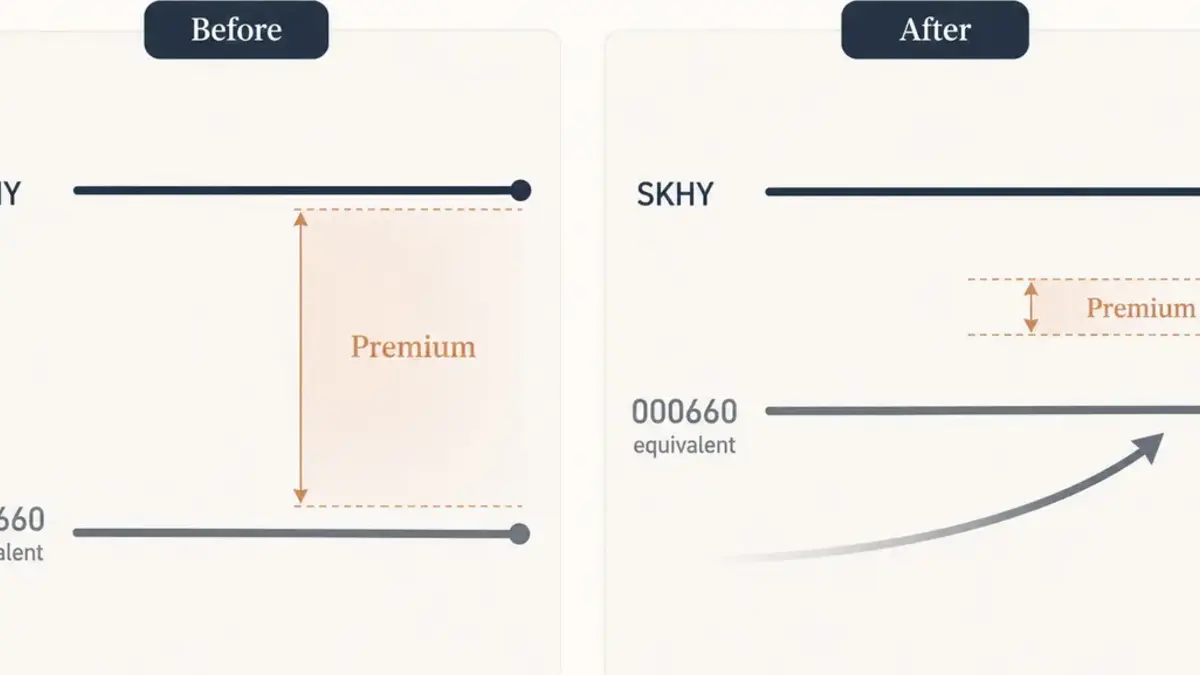
Picture two lines. One is SKHY. The other is the U.S.-dollar-equivalent value of 000660. The premium is just the distance between them.
If the lower line catches up with the upper one, the gap shrinks. The upper line doesn't need to move down.
Scenario 1: 000660 Rises Faster Than SKHY
The most straightforward path. Both markets are optimistic about SK hynix, but investors in Korea get more aggressive: SKHY rises 5% while 000660, after currency adjustment, rises 20%.
SKHY investors still make money. The premium contracts anyway, because the Korean shares are catching up.
Which is why a headline like "SKHY premium falls sharply" tells you so little on its own. It doesn't say whether SKHY went down. For that you need both sides of the calculation.
Scenario 2: The Korean Won Strengthens
There's a moving part people forget: USD/KRW. The Korean shares trade in won; SKHY trades in dollars. To compare them, the Korean price has to be converted first.
Say 000660 doesn't move at all in won, but the won strengthens against the dollar. The same Korean shares are now worth more in dollars, which raises the dollar-equivalent value behind each SKHY ADS. The premium falls anyway, with SKHY flat and 000660 flat in KRW. The exchange rate did all the work.
In practice, prices and currencies move together, so the effect usually shows up as a blend of the two.
Scenario 3: 000660 Rises and the Won Strengthens at the Same Time
Stack the two effects and compression gets fast. SK hynix shares rise in Korea, the won strengthens at the same time, and SKHY rises only modestly in New York. Both the share-price move and the currency move push the denominator up, while SKHY barely helps the numerator. A premium that looked solid in the morning can shrink far quicker than an SKHY-only chart would ever suggest.
Scenario 4: Korea Reopens and the "Live Premium" Suddenly Falls
There's also a market-timing wrinkle. SK hynix's ordinary shares trade in Korea; SKHY trades on Nasdaq, where ADR trading began on July 10, 2026.[2] Nasdaq's regular session runs 9:30 a.m. to 4:00 p.m. Eastern Time, with pre-market and after-hours sessions on either side.[3]
Korea's regular session runs 9:00 a.m. to 3:30 p.m. on the Korea Exchange.[4] The two regular trading sessions do not overlap: for much of the day, one market is trading live while the reference price from the other market reflects an earlier session. The displayed premium inherits that mismatch: it can look unusually large or unusually small simply because its two legs are priced at different times.
Here's a typical sequence. During U.S. hours, Korea has already closed and 000660's last price is fixed. Good news lands — an AI order, a memory-price report, whatever. SKHY jumps immediately, and the premium expands, because SKHY is reacting to information 000660 can't price yet. Then Seoul opens, Korean investors bid 000660 up on the same news, the underlying equivalent catches up, and the displayed premium drops, sometimes sharply. SKHY never fell. Part of what looked like premium was a timestamp gap. Our premium history page shows how the displayed premium has moved day by day since the listing.
This Is Why a "Live Premium" Needs Context
You see SKHY Premium: +30% on a screen. Read that as "U.S. investors are paying exactly 30% more for the same exposure" and you may be wrong. The first question to ask is: is Korea open?
If Seoul is closed and SKHY is still trading, the number mixes a current U.S. price with an older Korean one. The math is still correct. What changed is what the math means. During non-overlapping market hours, the observed premium can reflect both a persistent pricing gap and a temporary price-discovery mismatch between the two markets.
When Korea next trades, part of the mismatch can vanish just because the Korean price catches up. For historical analysis, comparing prices from consistent timestamps beats comparing two closes from different sessions.
Does a Falling Premium Mean SKHY Is Becoming Less Valuable?
Not necessarily. Imagine SKHY rises from $150 to $180 while the underlying equivalent value rises from $110 to $175. SKHY holders gained 20%. The premium went from 36.4% to 2.9%.
A dramatic collapse, if you're watching the premium. A strong rally, if you're watching the share price. Both statements are true at once. A falling premium tells you the relative gap is shrinking, and nothing more. It doesn't say which side moved, or whether your position gained or lost.
The Reverse Can Also Happen
The same logic runs backward. SKHY falls 5% — sounds bad. But if the Korean shares fall 20% at the same time, SKHY ends up at a larger premium than before, despite losing value.
| Before | After | |
|---|---|---|
| SKHY | $150 | $142.50 |
| Underlying equivalent | $125 | $100 |
| Premium | 20.0% | 42.5% |
SKHY fell. Its premium more than doubled. That's why the premium can't substitute for the SKHY price chart. They answer different questions.
What Would Cause a Major SKHY Premium Compression?
In practice, a large premium could narrow several ways, and the biggest compressions usually combine them. Why the premium exists at all, and why arbitrage doesn't erase it overnight, is a separate question, covered in Inside the SKHY Premium: Scarcity and Conversion Limits.
- 000660 rises faster than SKHY, closing the gap from the bottom.
- SKHY rises too, just more slowly than the Korean-equivalent value.
- The won strengthens, lifting the dollar value of Korean shares whose won price never moved.
- Korea reopens and prices in the news SKHY had already reacted to.
- Several of the above at once, moderate moves added together.
What Would a Return to Parity Look Like?
Parity means a premium of roughly zero: SKHY trading at about the U.S.-dollar-equivalent value of its Korean shares. Start again from SKHY at $170 and a Korean-equivalent value of $130. At least four paths get you there.
Path one, the one everyone pictures: SKHY falls from $170 to $130 while the underlying stays put. It happens. It's just not the only route.
Path two: Korea does the work. SKHY stays at $170; the underlying climbs from $130 to $170. Premium gone, and SKHY never fell.
Path three: both rise, to $190. The premium disappears, and SKHY holders made roughly 12% along the way.
Path four: they meet in the middle at $155, splitting the adjustment between SKHY weakness and underlying strength.
Nothing requires convergence to pick one path, and ADR premiums can wander for years without fully closing. The TSMC ADR's long record is a good reminder.
Premium Risk Is Different From Stock-Price Risk
Buying SKHY at a big premium means you're answering two questions at once. One: what happens to SK hynix as a company? Two: what happens to the valuation gap between SKHY and 000660? They're related, but they are not the same question.
The business could do well while the ADR premium contracts; the rising value of the company can offset some or all of the compression. Or both securities rise and 000660 simply rises faster. That's why "the premium might fall" is not the same claim as "SKHY must fall." The first is about relative pricing. The second is about an absolute share price.
What Should You Watch?
If you track the SKHY premium, the SKHY price alone isn't enough. Watch:
- the SKHY price
- the SK hynix 000660 price
- USD/KRW
- whether the Korean market is trading right now
- whether the U.S. and Korean prices come from comparable timestamps
Those variables explain why the premium moved. "SKHY +3%, premium −10 percentage points" is an incomplete sentence until you know whether 000660 surged, the won strengthened, Seoul reopened on new information, or some mix of the three.
The premium number is the result. The components are the story. Our live SKHY premium calculator puts all three inputs, SKHY, 000660 and USD/KRW, side by side, so you can see which side of the gap moved.
The Bottom Line
Yes — the SKHY premium can collapse without SKHY falling. SKHY can even rise while its premium falls, because the premium measures the gap between SKHY and the dollar-equivalent value of SK hynix's Korean shares, and the gap has two sides.
That gap narrows when 000660 rises faster, when the won strengthens, when Korean prices catch up after a market-hours mismatch, or when SKHY simply rises more slowly than the underlying shares. Usually several of these at once.
So the next time the SKHY premium drops from 30% to 10%, don't conclude that SKHY lost 20% of its value. Ask a different question: which side of the gap moved?
References
- U.S. Securities and Exchange Commission, SK hynix Inc. Final Prospectus, Form 424B4, July 2026. Confirms that each ADS represents one-tenth of one SK hynix common share, that the ADSs trade on Nasdaq under the symbol "SKHY", and that the common shares are listed on the KRX KOSPI Market under the identification code "000660".
- SK hynix Newsroom, SK hynix Lists ADRs on NASDAQ, Elevating Global Status at the Heart of Capital Markets, July 10, 2026. Official SK hynix announcement covering the start of Nasdaq ADR trading.
- Nasdaq, Market Activity, accessed August 17, 2026. Lists regular market hours of 9:30 a.m.–4:00 p.m. ET, pre-market trading from 4:00–9:30 a.m. ET, and after-hours trading from 4:00–8:00 p.m. ET.
- Korea Exchange, Guide to Trading in the Korean Stock Market (PDF). Lists the regular session for Korean stocks as 9:00 a.m. to 3:30 p.m. KST, with off-hours sessions outside that window.